Downloaded Claude skills are generic. They're bloated. They're built for one task at a time.
That's not even their biggest problem. The bigger problem is real business work doesn't happen one task at a time. Real work is a sequence of tasks that need to hand off to each other — research feeds into copy, copy feeds into design, design feeds into scheduling.
If you keep building skills in isolation, you'll never build out the systems that actually run a business end-to-end. So in this post I'll show you what I do instead — skill systems, where each output feeds into the next, and you stop being the duct tape holding it all together.
(If you're newer to Claude and want the basics on what skills + projects even are, start with how to use Claude projects and skills. This post assumes you've got the basics.)
The two mistakes most people make with Claude skills
Before the answer, the two ways this goes wrong. Both feel right at the time.
Mistake #1 — Building skills in isolation
The easiest way to see this is to think about how a real marketing team works.
You've got an email marketer. Their main job is writing emails, but they're also a strong copywriter, so they jump in on social captions when the social team needs them. They can read a GA dashboard, so when a launch wraps they pull open rates themselves and feed that back into the next campaign.
That's how real work gets done. Hand-offs. Output of one person becoming input for the next.
Now imagine you hired an email marketer who refused to do any of that. You ask for an email, they write the email, then they clock off. You're left finding the topic, doing the research, pulling the visuals, writing the subject-line variants, and reading the numbers afterwards.
That's a Claude skill in isolation. You download a copywriting skill. You ask it to draft a LinkedIn post. It does. Then you go and find the visual, you go and post it, you go and read the analytics. You used Claude like a chatbot — one question, one answer — and you're still the connector. You're the marketing department.
Mistake #2 — The mega-skill
The other failure mode is the opposite. You try to build one giant skill that does everything.
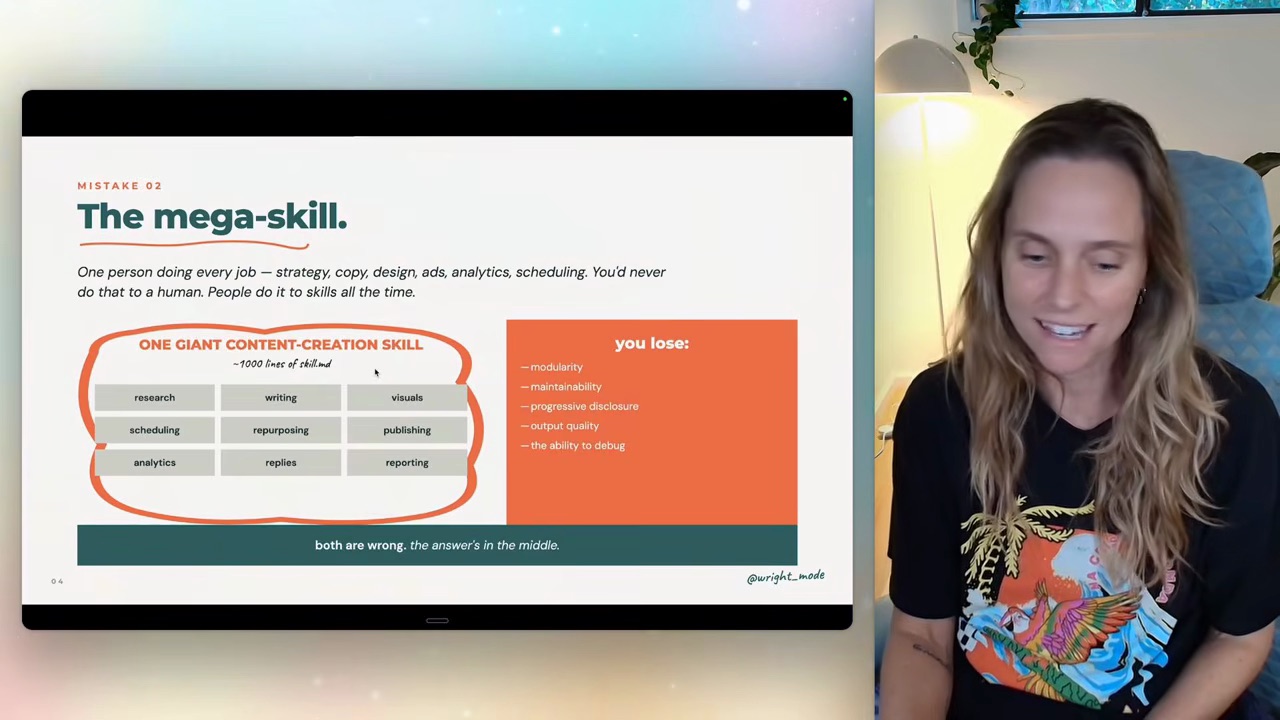
You write a "Weekly Content Skill" that's supposed to handle the topic, the research, the copy, the visuals, the scheduling — all in one massive markdown file. It looks impressive. Then you try to use it.
It fails because:
- It's too long — the context budget gets eaten by instructions before any actual work happens
- It can't be reused — the research part is now welded to the content part, so you can't lift research and plug it into another system
- When you update one thing, you risk breaking five others — touch the visual logic, accidentally regress the copywriting
The mega-skill is what people build when they understand "real work has multiple steps" but haven't yet learned the right shape of the answer. The shape isn't "one giant skill." The shape is small focused skills wired together.
What a skill system actually is
A skill system is small focused skills wired together by one orchestrator skill. That's it. That's the whole concept.
Same shape as a marketing team. Each person does what they're best at. Someone runs the room and knows what hands off to who and in what order. When to flag something for you to approve. Each sub-skill is small and good at one thing. One orchestrator at the top runs them in sequence.
You give one prompt. The orchestrator takes that prompt, runs the chain — research → copy → visuals → schedule — and drops you in at the checkpoints where it makes sense. You approve. It carries on.
This is actually how my content system works.
What an orchestrator needs to know
An orchestrator needs to know five things to actually work. Same five things any half-decent team lead would know.
- Architecture — which skills to run, in what order. (Does the copywriter start before the designer, or after?)
- Inputs — what each skill needs to do its job. (Brief everyone properly so they don't come back with three follow-up questions.)
- Handoffs — how the output of one becomes the clean input for the next.
- Checkpoints — where you step in to approve before it carries on. The "show me the draft before we send it" moment.
- Display — how the final result shows back to you. A clean summary, not a pile of files.
Five things. Don't overthink it.
Three skill systems you can build today
Enough theory. Three real systems, all running in my business right now.
System 1 — The pre-call brief builder
Someone books a call through your booking link. The skill system kicks in:
- Lead research skill — scrapes their site + LinkedIn for context
- Brief builder skill — creates a one-pager prep document
- Email drafter skill — replies with a tailored email and anything they need to do to prep for the call
By the time you walk into the call, you already know who they are and how to help them. No more "Sorry, can you remind me where you're at?"
One important thing about triggers. The Calendly booking itself isn't a skill — skills can't currently reach into apps and pull stuff themselves. The trigger is a separate layer. In Claude Cowork or with a scheduled task, the booking notification gets handed to the skill chain. In Claude chat, the most accessible version is just: open the chat, paste in the booking notification, the orchestrator picks it up and runs the chain. Same result, different plumbing.
System 2 — Discovery to proposal
A discovery call wraps. The system fires:
- Transcript skill — grabs the call transcript from Drive (works on Fathom, Zoom, anywhere it's stored)
- Pain-point extractor — pulls the specific problems the prospect named
- Proposal builder — drafts the proposal in your voice, with the right offer, the right scope, the right price
- Email drafter — drafts the send-off email with the proposal link
You go from "the call just ended" to "draft proposal in my inbox" in minutes. Not days.
System 3 — Weekly content production
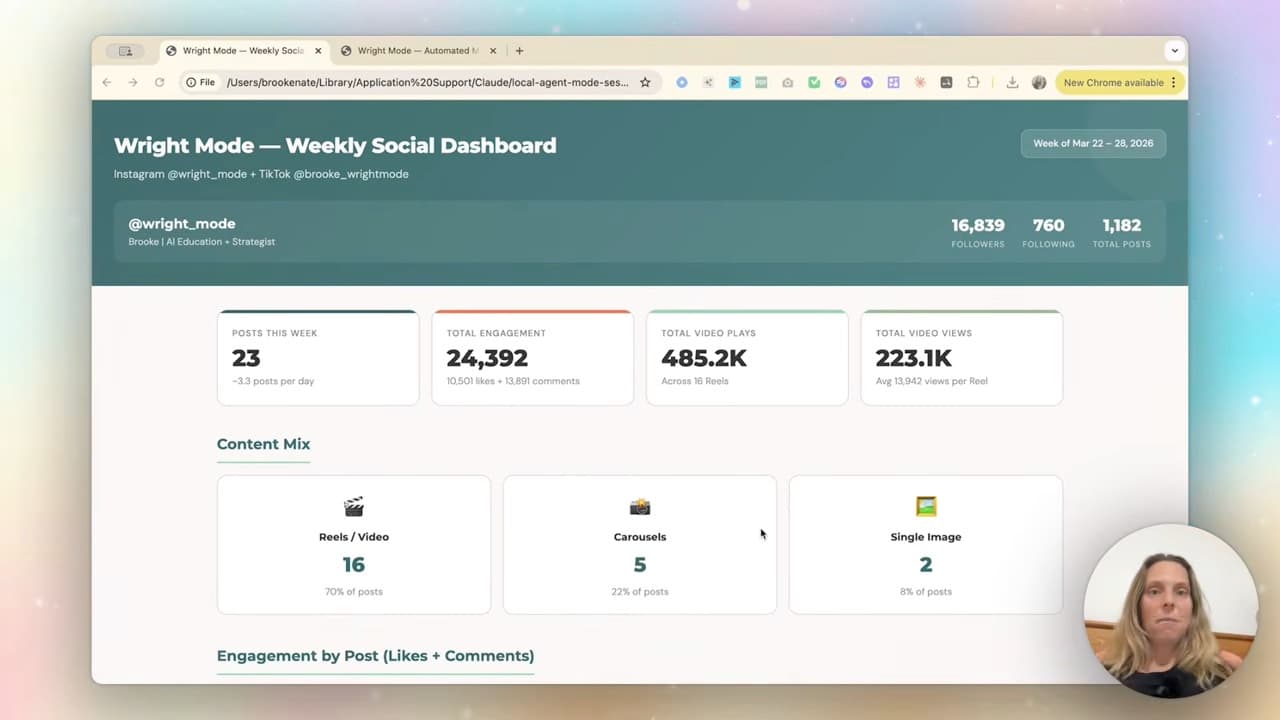
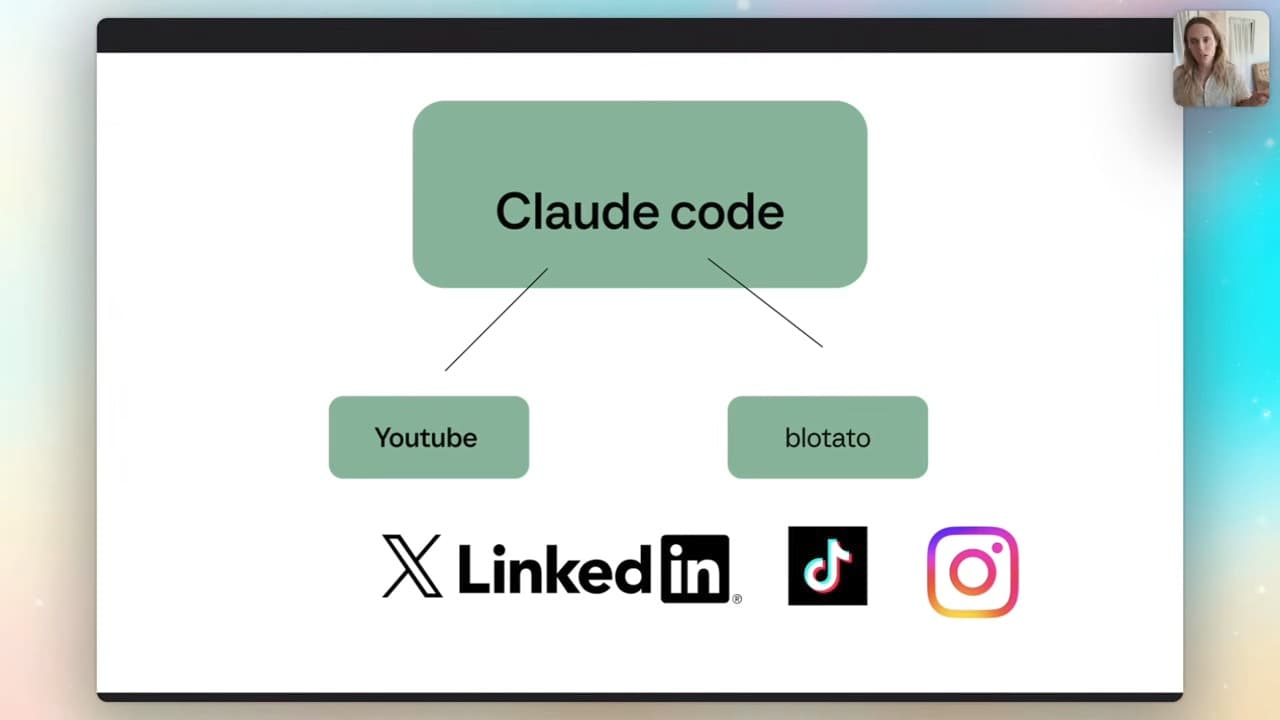
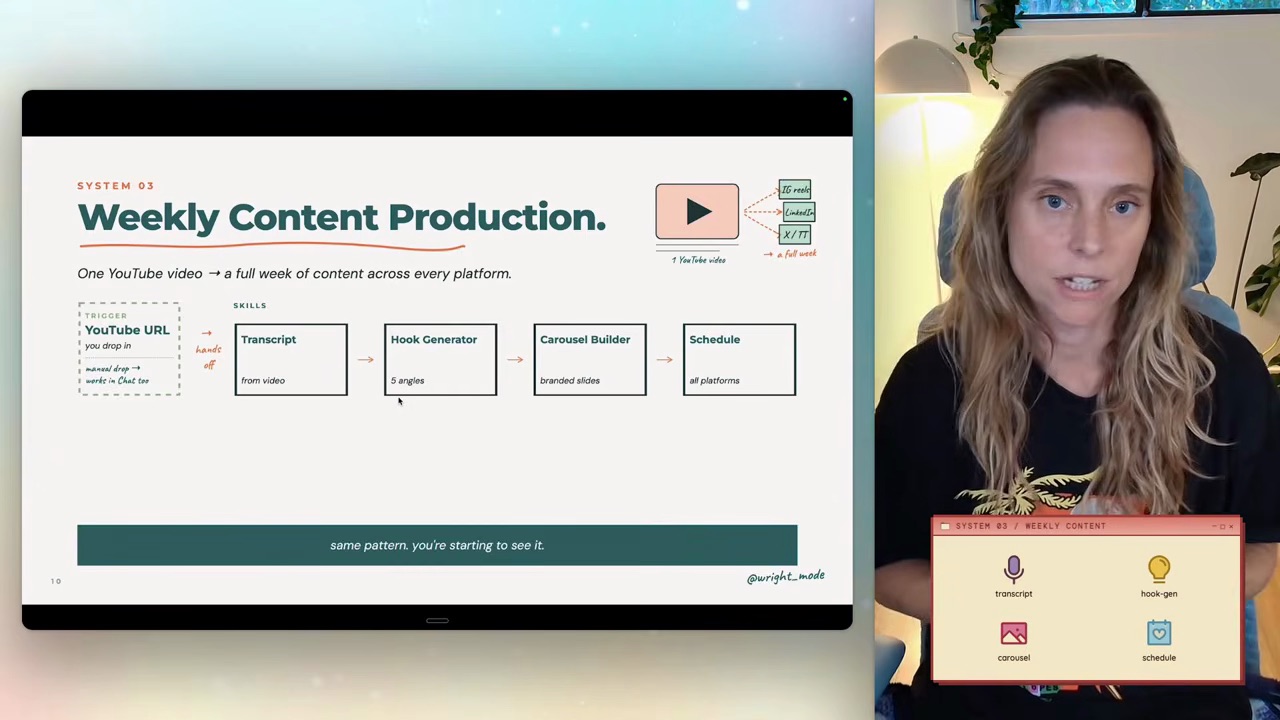
The one I run most. One YouTube video becomes a full week's content across every platform.
- Transcript skill — pulls the YouTube transcript
- Hook extractor — finds the strongest 3-5 moments
- Content builder — turns each into TikTok/Reel scripts + Instagram carousels
- Schedule skill — pushes the lot to Blotato for scheduling
Same source. Five outputs. One orchestrator running the chain.
(That weekly-content workflow has its own deep-dive — how I automate Instagram carousels from TikTok — if you want the carousel piece of the chain on its own.)
How to actually build one
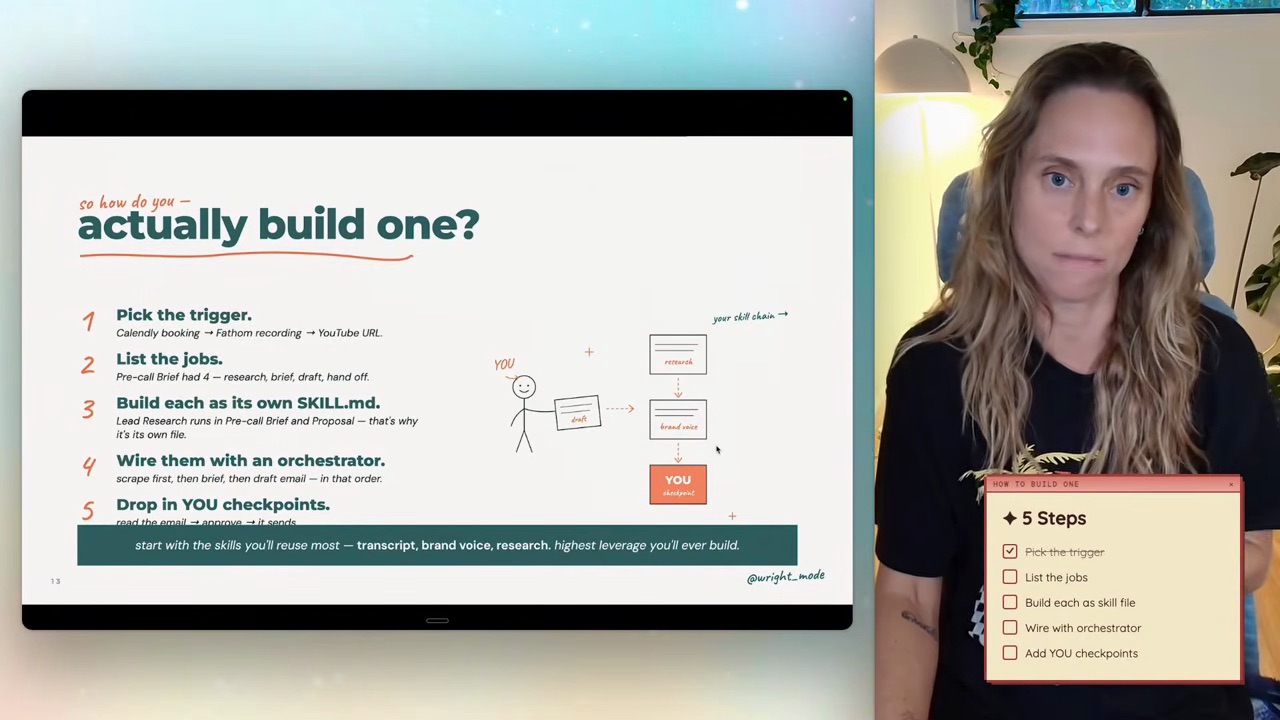
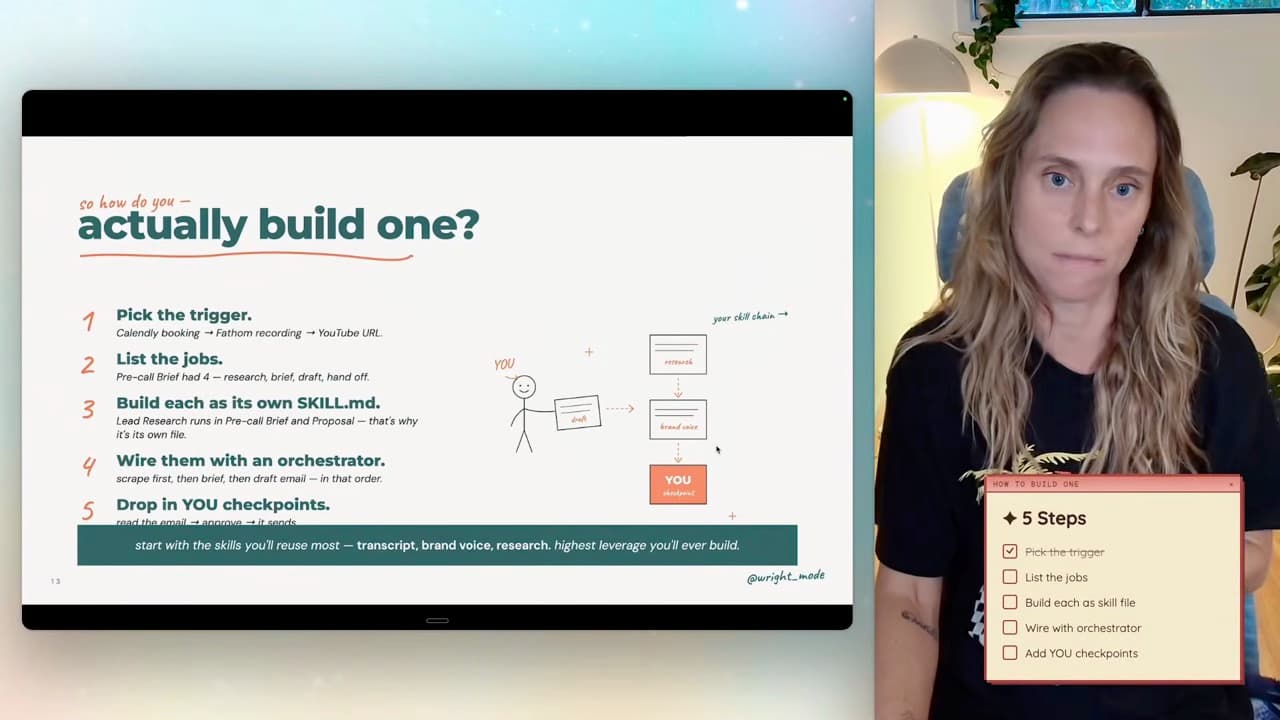
Five steps, in this order:
- Pick the trigger. What event kicks the chain off? Calendly booking, YouTube upload, manual paste. Be specific.
- List the jobs. Write down every discrete thing that has to happen between trigger and finish. One verb per item. (Research. Brief. Draft. Schedule. Notify.)
- Build each one as a small skill. Each skill does ONE job. Resist the urge to combine. The whole point is reusability.
- Wire them with an orchestrator. One skill at the top that knows the architecture, the inputs, the handoffs, the checkpoints.
- Drop in your checkpoints. Where do you need to approve before the chain carries on? Mark those spots in the orchestrator.
Start your build with whatever you're going to use first. Don't try to build all five at once. Get one system working end-to-end, then build the next.
Three rules for skill systems that compound
If skill systems were just "lots of small skills" that'd be enough. But the real leverage is in three rules that make them compound over time.
Rule 1 — One skill, one job
The "lead research" skill researches a lead. That's it. It doesn't also draft emails. It doesn't build the brief. The moment a skill does more than one job, it gets bloated, and you've accidentally built yourself a mega-skill in disguise — losing the ability to plug "lead research" into the discovery-to-proposal system because it's now tangled with brief-building logic.
Rule 2 — Build the skill, not the system
When I built my transcript skill, I didn't build it just for discovery calls. I built it knowing I'd run it on YouTube videos, podcast episodes, and TikToks. Anywhere a transcript exists, essentially. That's why it slots into three of my skill systems.
Build every skill for every system it might plug into. Not just the one you're working on right now.
Rule 3 — Update once, every system upgrades
This is the rule that makes skill systems pay off compounding.
When I improve the transcript skill once — better timestamps, cleaner output, smarter speaker labels — the pre-call brief system, the discovery-to-proposal system AND the weekly content system all get the upgrade at the same time. Three systems just improved. I fixed one file.
If your skills are buried inside mega-skills, you can't do this. You have to remember which mega-skill the transcript logic is in, dig it out, update it, hope you don't break the other things it touches. Compounded leverage requires composability.
FAQ
What's the difference between a Claude skill and a skill system?
A skill is a single markdown file that teaches Claude to do one job a specific way (e.g. "transcribe this audio file"). A skill system is multiple small skills wired together by one orchestrator skill, so they hand off to each other — research feeds into brief, brief feeds into email, etc. The orchestrator runs the chain in order, with you stepping in at checkpoints. Same architecture as a marketing team.
Why are downloaded Claude skills not enough?
Most skills you'll find in marketplaces (or that AI auto-generates) are built for one task in isolation — write a LinkedIn post, summarise an article, draft an email. Real business work is a chain of tasks. So a single isolated skill gives you a draft and then leaves you to do the other five steps yourself. The fix isn't a better single skill — it's stringing multiple small skills together.
How big should one Claude skill be?
Small. One job per skill. If you're describing more than one verb (e.g. "researches AND drafts") you've built two skills wedged together. Split them. The whole point is that each skill plugs into other skill systems unchanged — which is only possible if they stay focused.
Where do skill systems run — Claude chat, Cowork, or somewhere else?
You can run skill systems in Claude chat (you trigger the orchestrator manually), Claude Cowork (where the orchestrator can call sub-skills programmatically), or Claude Code (where you can wire in app triggers and scheduled tasks). The architecture is the same in all three. Cowork and Code unlock automatic triggers — chat needs you to kick it off each time.
What's a good first skill system to build?
The pre-call brief builder. The trigger is concrete (Calendly booking), the chain is short (research → brief → email draft), and the payoff is immediate — you stop walking into discovery calls cold. Once that works end-to-end, build the discovery-to-proposal system next.
If you want help actually building skill systems for your business — your triggers, your orchestrator, the chain of small skills — that's the work we do inside Wright Mode. Fortnightly Build-with-Brooke sessions where we wire these up together, plus the templates I use in my own business. If you'd rather have a system built specifically for you, book a Wright STACK Consult and we'll do it in 90 minutes.