She trained under Marie Kondo. In Japanese. She spent six years organising strangers' homes as one of the world's first certified KonMari consultants.
She has never written a line of code.
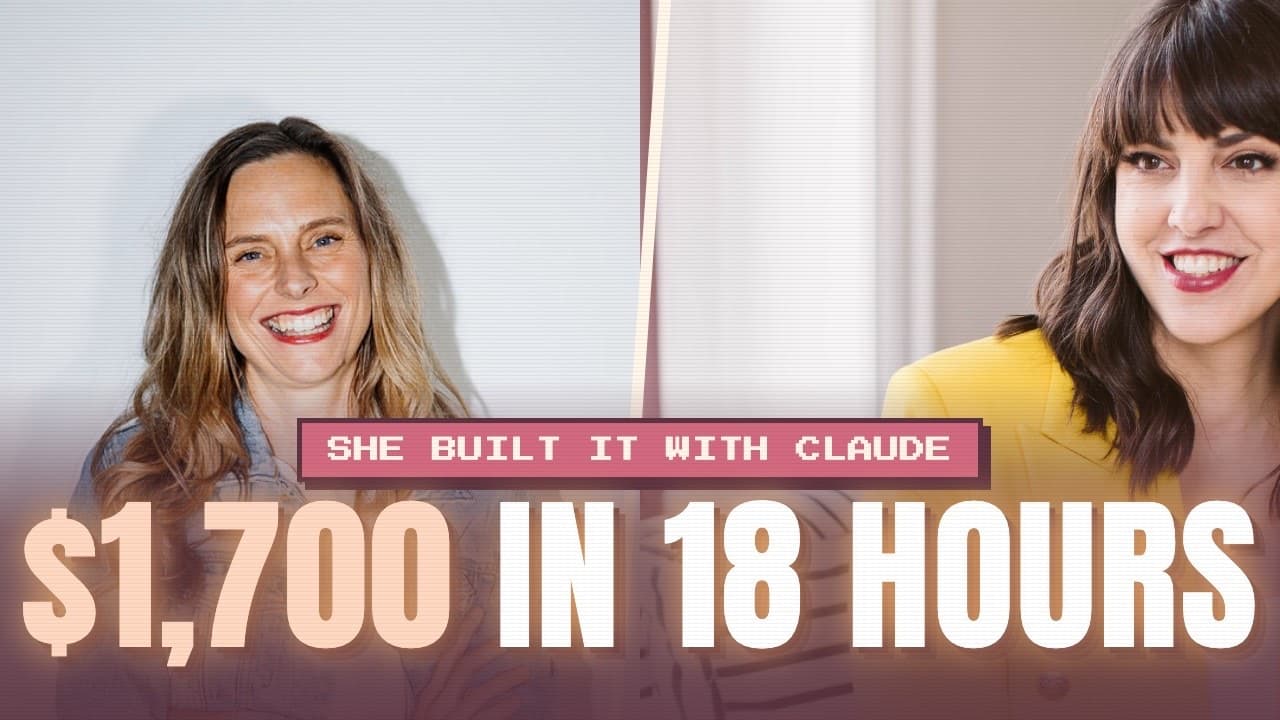
Last month she typed one paragraph into Claude Cowork and made $1,700 in the first eighteen hours from a tool that didn't exist the day before.
Here's the part everyone gets wrong about that sentence: the AI is not the story. Claude deleted one excuse — "I'm not technical enough to build something." Every other reason Amanda Jefferson is now a software founder was already hers.
I sat down with Amanda on the Not Another AI Girl podcast, and it's the best "you're more capable than you think" hour I've recorded all year. Here's what she actually did — and the four moves you can copy.
You don't need to code to build a digital product
Amanda's whole career was making order out of chaos — first in people's homes, then in their digital lives, teaching people the difference between the cloud and their desktop, where their files actually live, what archive versus delete means.
Then tech and productivity started changing every five minutes, and her old "record it once and sell it" digital product stopped cutting it. So she opened Claude Cowork and built something for herself.
If you've never touched Cowork, it's the tool that lets you describe what you want in plain English and have it build the thing — no developer, no code editor. My Claude Cowork tutorial walks through the basics, but Amanda's approach is the fastest way to understand the mindset.
Move 1: prompt for the outcome, not the task
This is the one I want tattooed on people.
Amanda didn't sit down and tell Claude "make a header, add a button, now a checkbox." She'd tried Notion, Asana, a dozen other tools, and none of them let her get her hands in the way she wanted. So she did the thing she says is the whole secret:
She just talked to it.
I wish I could find the prompt, but it was just a paragraph. Just me — okay, I went about this thing, I wanted to do this, and this. What do you got? And when it spit out, I was like, are you kidding me? It was so close to exactly what I was looking for, but beyond.
She described the outcome — the finished thing, how it should feel to use — and let Claude work out the how. She wasn't the developer. She was the person who knew exactly what "done" looked like, and that turns out to be the rarer, more valuable skill. If you can't describe the outcome, no amount of prompting saves you. If you can, the build is the easy part now.
The detail I can't stop thinking about: she asked it for confetti when you tick a task off, and a pep talk from an avocado. Because she has ADHD and, in her words, "the dopamine needs of a toddler." Most productivity tools are boring because they were built by people who don't need them. Amanda built one that's genuinely fun to use — and for her brain, fun is the difference between using it and abandoning it. That's not a gimmick. That's product design.
Move 2: launch before you feel ready
You're "supposed" to launch at noon on a Tuesday.
Amanda shipped hers at 10pm on a Monday, in beta, full of glitches, because — her words — "I find that when I do everything wrong, everything goes right."
She hit send to her email list. Then five minutes of nothing. Ten. Fifteen. "Oh god, this is a total flop." Then it started, and it didn't stop. $1,700 in eighteen hours, around $10,000 by the end of that week.
Two things worth stealing there. First: her 4,000-person email list did the work — not her 175,000 Instagram followers. The tiny list converts. Guard your list. Second: she shipped before she felt ready, on purpose, because she knows the people she knows have been "perfecting" the same product for months and it's still not out. You learn more from one real launch than six months of polishing in the dark.
Move 3: turn your buyers into your design team
This is the move most people skip, and it's the one that made the product good.
Amanda built a feature-request form straight into the planner. Instead of guessing what to build next, her buyers told her — "could I make my own categories? could I add colours?" — and she built the good ones. Her line to those users now: "we built this together." The planner is night-and-day from launch, and she says 99% of that is their ideas.
The form did something she didn't expect, too. It became a love-note machine — people wrote in with no request at all, just to say how much they loved it. Straight onto the sales page.
And a counterintuitive one: she tried a 7-day money-back guarantee and then killed it. Not because she doubts the product — because the refund requests never came with the why she was hoping to learn from. Sometimes the "best practice" costs more than it earns. Test it, watch it, drop it. (When she built her actual sales page for this, it was the same plain-English approach — here's how to build a sales page with Claude Code if that's your next step.)
Move 4: have the product ready BEFORE the attention comes
Here's the one that flips the whole "build an audience, then sell to it" playbook on its head.
In December, Amanda had a silly idea — put tech tips in a jar, pull one out each day, riff on it. A 30-day series. She went from 6,000 followers to 100,000 in four days.
And this is the whole point:
Thank god I had a digital product in place when that happened. I think I made $30,000 in 10 days — because I had a digital product in place. Those followers aren't going into my bank account.
Most people spend two years growing an audience for a product that doesn't exist yet. Amanda did it backwards — product first, audience second — so when the lightning struck, it had somewhere to land. Her philosophy, borrowed from her mentor Maria Wendt: your $27 digital product is basically your lead magnet. It seeds warm buyers, funds the higher-ticket work, and it's ready when your moment comes. Her advice for anyone drowning in AI gurus? Follow one person, one strategy.
FAQ
Can you build a digital product without knowing how to code?
Yes. Amanda built and sold an interactive planner using Claude Cowork without writing any code — she described the outcome she wanted in plain English and Claude built it. The skill you need isn't coding, it's knowing exactly what the finished product should do.
How much can you make selling a digital product built with AI?
Amanda made $1,700 in the first 18 hours of her launch and around $10,000 that week, from a $37 one-time-purchase tool. When a separate viral moment hit, she made roughly $30,000 in 10 days because the product was already built and ready to sell.
Do you need a big audience to sell a digital product?
No. Amanda's 4,000-person email list converted far better than her 175,000 Instagram followers, and her first launch succeeded off that small warm list. A ready product plus a small engaged audience beats a big following with nothing to sell.
What's the best way to improve a digital product after launch?
Let your buyers tell you. Amanda built a feature-request form into her product and says 99% of its improvements came from customer ideas — which also turned buyers into co-designers who kept buying and referring.
The real takeaway
The wall Amanda used to stand behind — "I'm not a tech person, I could never build software" — is gone. Claude took it down. But everything on the other side of that wall was already hers: the taste to know what to build, the nerve to ship it, the humility to let buyers steer. The AI didn't make her a founder. It just stopped being her excuse not to be one.
Amanda built every one of those tools inside my membership — in a member show-and-tell, in the same room some of you are already sitting in. If you want to build this stuff with real support, alongside other women founders who are implementing AI instead of just reading about it, that's what we do inside the Wright Mode membership. Come and join us.